
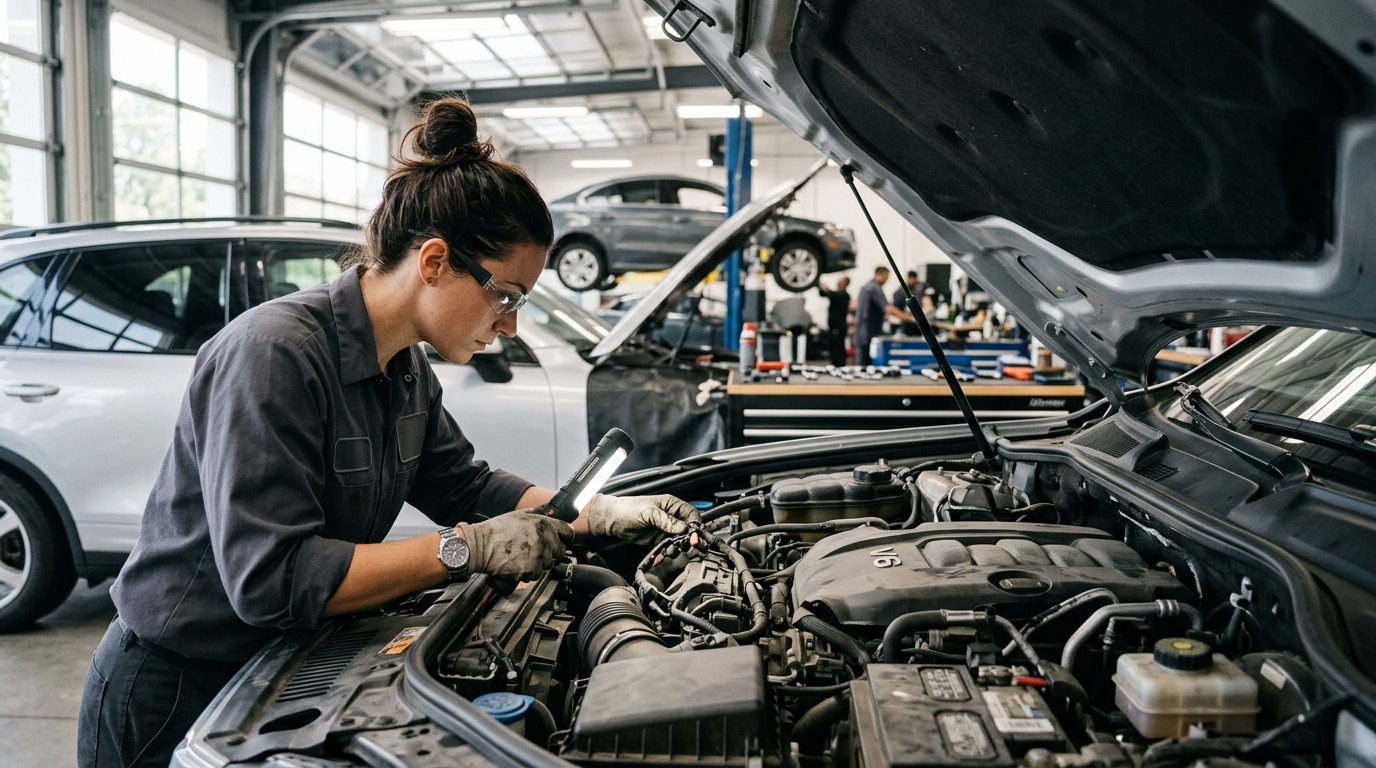
Intense Texas summers push cars far beyond normal operating conditions. When triple-digit temperatures hang on across Spring, TX, components face thermal stress, faster chemical breakdown and more friction. Handling that summer wear with fall car maintenance in Spring, TX prevents expensive breakdowns and keeps your vehicle running smoothly into the cooler months.
- Heat does hidden damage. It breaks down fluids, weakens batteries and speeds tire wear on Southeast Texas roads.
- Inspect after summer. Focus on cooling, brakes, the charging system and cabin filtration.
- Stay ahead of it. Proactive service extends engine life, improves fuel economy and prevents major failures.
Quick answers
Why does heat drain car batteries faster than cold?
Heat evaporates battery electrolyte, speeds up internal grid corrosion and reduces cell capacity. The damage happens in summer, and the battery often fails suddenly once temperatures shift.
What fluids need checking right after summer?
Engine coolant, motor oil, transmission fluid and brake fluid. Each should be checked for heat-related breakdown, contamination or volume loss.
How often should Texas drivers check their tires?
Check pressure and tread depth monthly. Pavement temperatures above 140°F speed up rubber wear and cause bigger pressure swings.
The real problem: hidden wear from months of hot pavement
Wear rarely happens all at once. In a Spring summer, engine bays routinely pass 200°F in traffic on I-45 or the Grand Parkway. That sustained heat attacks rubber belts, plastic connectors and lubricants.
Many owners assume that because the temperature gauge stayed steady through July and August, the car came through fine. In reality, heat breaks down additives in lubricants, causes micro-cracks in cooling hoses and thins the protective film in engine oil.
When fall brings bigger swings between morning and evening temperatures, parts weakened by summer start failing with little warning. Alternators give out, water pumps leak at worn seals, and brake pads squeal as the friction material glazes.
Modern vehicle health monitoring and predictive maintenance
Cars have changed a lot in the past decade. They now carry dozens of sensors, advanced engine control modules and electrical networks that run everything from direct fuel injection to driver-assistance systems.
When heat strains the alternator or battery, those networks see voltage drops that can trigger false warnings or make modules misbehave. That is why modern maintenance needs diagnostic equipment that reads full system data and spots weak components before a light appears on the dash. We covered what that looks like in practice in our guide to high-tech diagnostics.
Fall maintenance in practice: a component-by-component guide
1. Cooling system and radiator
Your radiator, water pump and thermostat work nonstop to shed engine heat. During long hot spells, the coolant’s rust and scale inhibitors wear out, which leads to internal corrosion and water pump seal failure.
- Coolant mix — keep a 50/50 ratio of distilled water and the manufacturer’s approved coolant for boil-over and freeze protection.
- Hoses — squeeze them with the engine cold. Soft, spongy or brittle spots mean the rubber is breaking down inside. See our belts and hoses service.
- Pressure cap — make sure it holds the correct pressure so coolant doesn’t boil early.
2. Battery and charging system
Winter cold makes a weak battery struggle, but summer heat does the original damage. Electrolyte evaporates, exposing the lead plates to sulfation and fast degradation.
- Voltage — a healthy 12-volt battery reads 12.6 volts or more at rest and 13.8–14.5 volts running. We test it free with battery service.
- Terminals — clean off white or bluish corrosion with a terminal brush and protective sealant.
- Hold-downs and cables — make sure brackets and cables are tight so vibration doesn’t damage the battery.
3. Motor oil and lubrication
Oil lubricates and cools the engine. Sustained heat shears both conventional and synthetic oil, lowering viscosity and leaving bearings open to metal-on-metal contact.
- Level and condition — check the dipstick. Dark, thick or gritty oil needs changing now.
- Filter — always replace it with the oil change so oil circulates freely.
- Specification — use the exact oil weight and spec in your owner’s manual.
4. Brakes and hydraulic lines
Braking creates a lot of friction heat. Add high outside temperatures and humidity, and brake fluid absorbs moisture, lowering its boiling point and making the pedal soft in hard stops.
- Pad thickness — replace pads before they drop below 3 mm to avoid scoring the rotors.
- Rotors — check for glazing, deep grooves or thickness variation that causes steering vibration.
- Fluid flush — replace brake fluid every two years to remove water and protect the ABS unit. More in our brake and alignment service.
5. Air conditioning and cabin filtration
Texas AC systems run at full output for months. Evaporators collect dust, humidity and organic material, which cuts airflow and causes odors.
- Refrigerant pressure — check operating pressures to find slow leaks before the compressor is damaged. See our AC and heating service.
- Cabin air filter — replace it to restore airflow and keep pollen and dust out of the cabin.
- Condenser — clear leaves, bugs and debris from the fins so heat can escape.
Key maintenance intervals at a glance
General guidance for Texas drivers — your owner’s manual has the final word for your vehicle.
Tailored solutions for different driving profiles
Daily commuters and highway drivers
- Focus — tire balance, alignment, oil protection and wiper condition.
- Watch for — stop-and-go traffic on I-45 heats transmission fluid, so keep transmission fluid service on schedule.
- Best approach — a multi-point inspection at every oil change to catch small wear items early.
Trucks, SUVs and tow vehicles
- Focus — differential oil, transmission coolers, heavy-duty brake pads and suspension bushings.
- Watch for — towing a boat or trailer in the heat puts extreme strain on the drivetrain and cooling system.
- Best approach — follow the severe-service schedule with shorter fluid intervals.
Commercial fleets and small business vehicles
- Focus — maintenance logs, commercial inspection compliance, charging systems and tire life.
- Watch for — unplanned downtime hits customer service and revenue directly.
- Best approach — a structured fleet program with inspections scheduled outside peak hours.
Putting maintenance off tends to cost more later, as we covered in our guide to beating rising repair costs in Spring.
Why choose Auto Care USA for maintenance in Spring, TX
Auto Care USA has been family-owned since 1988, serving drivers across Spring, Houston, Rosenberg and Katy.
At our Spring shop on Champion Forest Drive, we believe in honest communication and full transparency. Our ASE-certified technicians show you what we see with photo-and-video digital inspections and explain needed repairs before any work begins. We’re a BBB-accredited business and AAA Approved Auto Repair facility, and we service all makes and models, including commercial fleet accounts. Qualifying repairs are backed by our 2-year / 24,000-mile nationwide warranty.
Have an extended warranty plan? We’ll diagnose it, help submit your claim, and send you home with a free oil change.
Frequently asked questions
How does the Texas vehicle inspection work now?
Since January 1, 2025, non-commercial passenger vehicles no longer need an annual safety inspection anywhere in Texas. Emissions testing is still required in designated counties, including Harris County where our Spring shop is located, and regular mechanical checkups remain the only real safety net.
Can hot weather cause my check engine light to come on?
Yes. Heat makes fuel vapor expand in the tank, which can set evaporative emission codes. It can also cause misfire codes if ignition coils or spark plug boots have been damaged by heat.
What is the difference between regular and extended-life coolant?
Traditional inorganic-additive coolant is usually replaced every 2 years or 30,000 miles. Organic acid technology extended-life coolant can last up to 5 years or 100,000 miles. Always use the exact formula your manufacturer specifies to avoid chemical incompatibility.
How often should my brakes be inspected?
At least twice a year or every 10,000 miles. If you hear grinding or squeaking, feel vibration when slowing, or notice more pedal travel, schedule an inspection right away.
For the full breakdown of what changed, see what Texas drivers still owe after the safety inspection repeal. Our Spring shop handles required emissions testing and repair.
Prepare your vehicle with confidence
Routine care protects your investment, improves fuel economy and gives you peace of mind on the road. Don’t wait for a warning light or a strange noise to leave you stranded.
For trusted maintenance and diagnostics in Spring, TX, turn to the ASE-certified team at Auto Care USA. Visit us at 18602 Champion Forest Dr or schedule an appointment.
Related reading
- How Spring, TX Auto Care Shops Are Helping Drivers Catch Up on Maintenance This Fall
- How to Beat Rising Auto Repair Costs in 2026: A Spring, TX Owner’s Guide
- Why Your Car AC Blows Warm Air: Complete Guide to AC Repair in Rosenberg, TX
- Texas Ended the Safety Inspection. Here’s What Briar Forest Drivers Still Owe in 2026
Free post-summer inspection
18602 Champion Forest Dr, Spring, TX 77379 — walk-ins welcome.