
When you start your car on a scorching Texas afternoon and hot air blows from the vents, the commute gets unbearable fast. Finding AC repair in Rosenberg, TX you can trust is one of the most common car problems across Fort Bend County. Automotive air conditioning runs under high pressure in intense heat, so regular inspections and accurate testing are what keep the cabin cool.
- AC doesn’t use up refrigerant. Warm air almost always means a leak, a faulty compressor or an electrical problem, not simple fluid loss.
- DIY cans are risky. Canned refrigerant can over-pressurize the system and destroy the compressor.
- Early testing saves money. Leak detection, pressure testing and digital inspections protect the major components from heat damage.
How automotive air conditioning works under high heat
Your AC doesn’t create cold air. It removes heat and moisture from the cabin and moves that heat outside. That sealed loop depends on several parts working together:
- Compressor — the heart of the system. It pressurizes refrigerant and pumps it through the loop when you press the A/C button.
- Condenser — in front of the radiator. It turns hot, high-pressure gas from the compressor into liquid by releasing heat into outside air.
- Expansion valve or orifice tube — restricts flow and drops pressure, which makes the refrigerant extremely cold as it heads into the cabin.
- Evaporator core — behind the dashboard. The blower pushes cabin air across it, pulling out heat and humidity before the air leaves the vents.
- Receiver-drier or accumulator — filters debris and absorbs moisture that would otherwise cause acid and corrosion inside the system.
When any one of these degrades, cooling drops quickly. Long exposure to high outside temperatures speeds up rubber seal wear and raises operating pressures, which is why leaks show up early in cars that go uninspected.
How modern climate control has changed
Older vehicles used cables to move simple blend doors, with basic pressure switches cycling the compressor. Modern vehicles use electronic climate computers, multi-zone blend door actuators, variable-displacement compressors and cabin temperature and humidity sensors. That is why computer-aided diagnostics are now part of almost every AC job.
Refrigerants have changed too. Vehicles built before 1994 used R-12, vehicles from the mid-1990s through the 2010s used R-134a, and most newer cars and trucks use R-1234yf. Servicing R-1234yf requires dedicated recovery machines, gauges and precise charging equipment.
Common causes of car AC failure in Texas driving
Why does an AC suddenly blow warm? These are the failures we see most in our bays:
1. Refrigerant leaks
AC systems are sealed, so they don’t use refrigerant in normal operation. If the level drops, there is a leak. Common spots are rubber O-rings, crimped hose connections, stone chips in the condenser and corroded evaporator cores. Running low also starves the compressor’s internal bearings of oil, which travels with the refrigerant, and that friction is what destroys compressors.
2. Electrical and control malfunctions
Modern climate systems rely on sensors, relays and computer modules. A failed high-pressure switch, a blown fuse, a bad ambient temperature sensor or a shorted harness can keep the compressor clutch from engaging — leaving you with lukewarm air even when the refrigerant charge is full. If a dash light is on too, a check engine scan is the first step.
3. Condenser blockage and damage
The condenser sits right behind the grille, so it collects dirt, bugs, leaves and road debris. When airflow through its fins is restricted, the refrigerant can’t shed heat, pressures spike, and safety switches shut the cooling down.
Professional AC diagnostics in practice
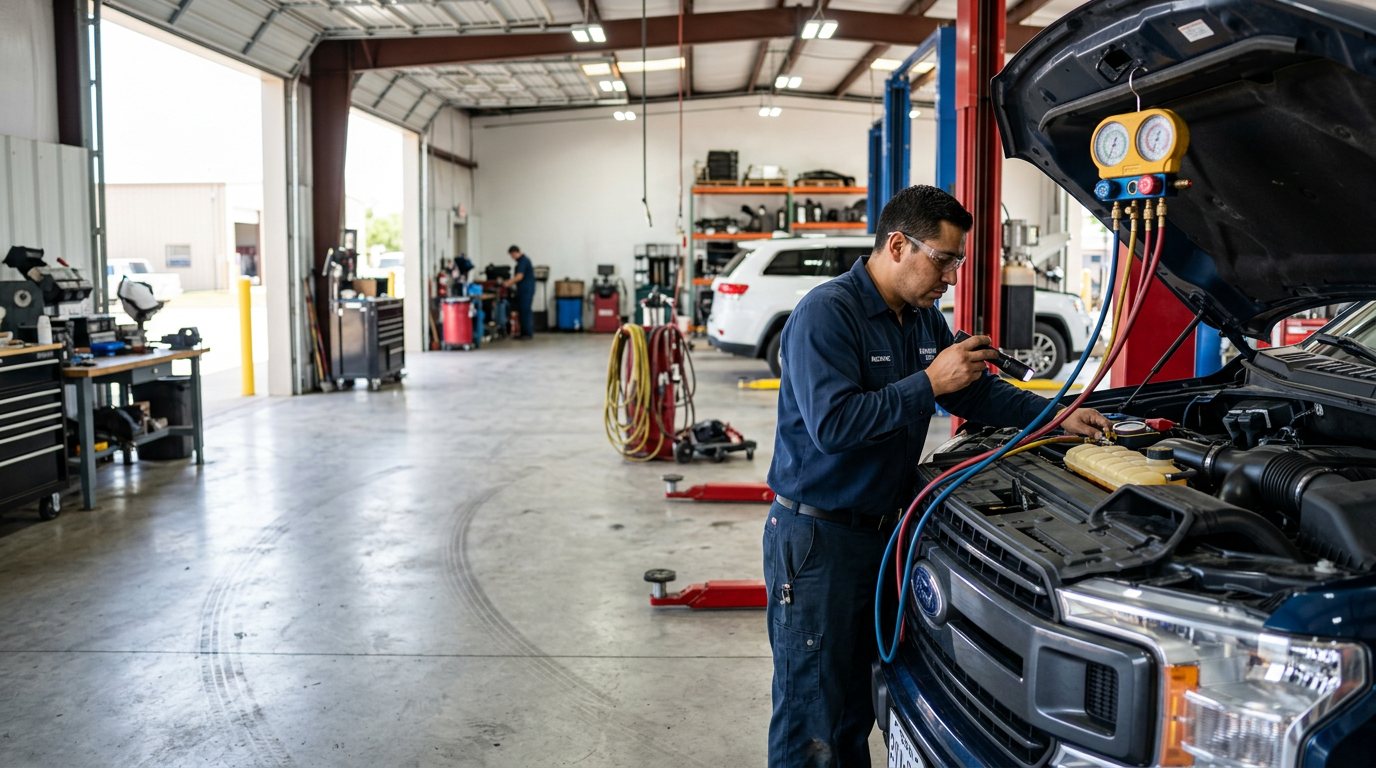
Diagnosing AC takes more than guessing or adding a can of refrigerant. A good technician works through a standard process:
- Performance and vent temperature check — recording outside temperature, humidity and center-vent temperature at several blower speeds to set a baseline.
- High- and low-side pressure testing — calibrated gauges show live operating pressures, and the split tells a weak compressor apart from a clogged expansion valve or a low charge.
- Electronic leak detection — sensitive detectors find small gas leaks at fittings and coils.
- UV dye — dye in the system glows under UV light and shows the exact leak path.
- Nitrogen pressure decay test — pressurizing an empty system with dry nitrogen confirms it holds before it is refilled.
- Electrical and actuator scan — a scan tool reads the body control module, verifies sensor readings and commands the blend doors to confirm proper temperature mixing.
Tailored solutions for different vehicles and driving habits
- Daily commuters and highway drivers — high mileage on Highway 59 means vibration and road debris. Checking the condenser for stone damage and cleaning it each spring prevents sudden cooling loss. Highway 59 is hard on more than AC, as we covered in our Rosenberg brake guide.
- Family SUVs and minivans with rear climate — rear evaporators mean long underbody refrigerant lines near exhaust shields and wheel wells. They need regular checks for corrosion and debris damage.
- Fleet and commercial trucks — long idle hours in summer heat load up cooling fans and compressors. Scheduled refrigerant checks and fan tests keep trucks working. Our Rosenberg shop runs a dedicated fleet bay.
- Vehicles over 8 years old — older hoses and compressor shaft seals lose elasticity. Replacing worn O-rings during scheduled maintenance avoids a mid-summer breakdown.
Engine cooling and cabin cooling share the same front-end airflow, so we check the water pump and belts and hoses at the same visit.
Why choose Auto Care USA in Rosenberg, TX
When you need reliable auto repair in Rosenberg, TX, Auto Care USA provides complete car care. Our Rosenberg shop at 5757 Reading Rd (77471) has been family-owned and committed to customer satisfaction since 1988.
- ASE-certified technicians — computer-aided diagnostic equipment for precise testing on all makes and models.
- Digital vehicle inspections — photos and videos sent to your phone, so you see what our technicians see before any work begins.
- 2-year / 24,000-mile nationwide warranty — qualifying repairs are covered on parts and labor under our nationwide warranty.
- No upsells — fair, upfront estimates and straight recommendations.
- Full-service shop — beyond AC, we handle brakes and alignment, oil changes, batteries, suspension and emissions testing and repair.
Have an extended warranty plan? We’ll diagnose it, help submit your claim, and send you home with a free oil change.
Frequently asked questions about car AC repair
Can I just recharge my car AC myself with a store-bought can?
DIY cans often do more harm than good. Stop-leak additives can gum up expansion valves and contaminate shop recovery machines, and without reading high- and low-side pressures at the same time it is easy to overfill the system and damage compressor seals.
How often should my vehicle’s air conditioning system be serviced?
Have the cabin air filter and A/C performance checked at least once a year, ideally in early spring before the heat sets in. Routine checks catch small O-ring leaks before they cause major component failures.
What does it mean if my car AC smells like vinegar or old gym clothes?
Sour or musty odors usually mean moisture has built up on the evaporator core and mildew is growing in the HVAC housing. A new cabin air filter and an evaporator cleaning treatment will clear it up.
Why is my AC cold on the highway but warm at stoplights?
That points to poor airflow across the condenser. At highway speed, incoming air cools it; stopped, the system depends on the electric cooling fan. A failing fan motor or a dirty condenser is the usual cause.
Keep your cabin cool with trusted Rosenberg auto care
Driving without working AC in Southeast Texas is more than uncomfortable — it can make the daily commute a safety hazard. If your vents blow warm or the system is making strange noises, early testing saves time and money.
At Auto Care USA Rosenberg, our ASE-certified team provides honest, dependable car care for drivers across Rosenberg and Fort Bend County. Visit us at 5757 Reading Rd or schedule your digital inspection today.
Related reading
- Essential Fall Car Maintenance in Spring, TX: How Texas Heat Impacts Your Vehicle
- Beat the Heat: Essential August Car Maintenance for Rosenberg Drivers
- Why Professional Brake Repair in Rosenberg, TX Is Your Best Defense Against Highway 59 Traffic
- Why Late-Season Heat Causes Sudden Failures: Complete Guide to AC Repair in Katy, TX
- Texas Ended the Safety Inspection. Here’s What Briar Forest Drivers Still Owe in 2026
Free AC performance check
5757 Reading Rd, Rosenberg, TX 77471 — walk-ins welcome.