
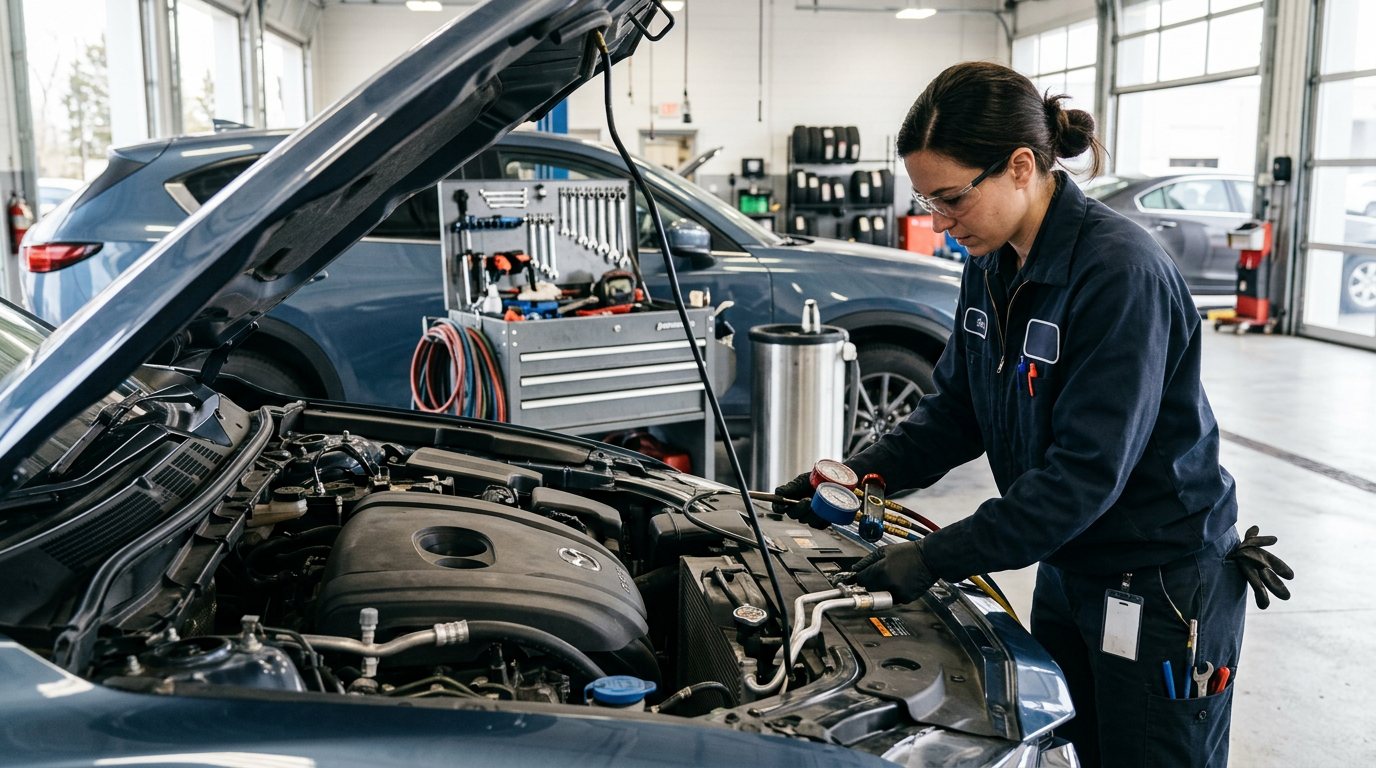
Months of continuous summer driving across Greater Houston push automotive cooling systems to their mechanical limits. When temperatures stay high well into late September, subtle refrigerant leaks and worn compressor clutches suddenly turn into complete cooling loss. Timely AC repair in Katy, TX prevents expensive secondary compressor damage and restores reliable cabin comfort.
- Heat ages the seals. Texas heat hardens hoses and O-rings, turning tiny pinhole leaks into sudden pressure loss.
- Canned sealant backfires. DIY stop-leak often clogs expansion valves and internal orifices instead of fixing the leak.
- Diagnose before it seizes. A full digital diagnostic finds bad relays, clogged condensers and leaks before the compressor fails.
Quick answers
What causes a car AC to stop blowing cold after summer?
Months of high system pressure speed up small leaks at rubber O-rings, and dirt built up on the condenser keeps it from shedding heat. The compressor then hits its safety cutout and stops cooling.
Can low refrigerant fix itself or be topped off indefinitely?
No. Automotive air conditioning is a sealed loop. Low refrigerant always means an active leak, and the leak has to be repaired before the system is recharged.
How long should an auto AC repair take?
A standard leak test, evacuation and component replacement usually takes 2 to 4 hours with proper diagnostic equipment.
Understanding summer thermal strain on automotive AC systems
Driving Interstate 10 or sitting in rush-hour traffic on the Grand Parkway puts exceptional thermal stress on your vehicle's cooling circuit. From May through September, your air conditioner runs at sustained high pressure against temperatures in the upper nineties and heavy Gulf Coast humidity. By late summer, parts that started the season with minor wear are often pushed past their limits.
Automotive air conditioning does not create cold air. It pulls heat out of the cabin through the evaporator coil and releases it outside through the condenser, which sits in front of the radiator. When outside air stays hot, getting rid of that heat is harder, so the compressor works harder and runs at higher head pressure to keep cooling.
That load adds up. Rubber seals dry out, hose crimps loosen from engine vibration, and electrical switches cycle far more often than they would in a milder climate. What feels like an overnight failure is almost always the result of months of extreme operating conditions. It is the same pattern we described in our August guide to A/C repair in Katy, just further along.
Common symptoms of car AC failure in Texas
Catching early warning signs lets you fix a problem before it becomes major component damage. On modern vehicles, early detection can be the difference between replacing an inexpensive seal and buying a new compressor.
- Gradual loss of cooling at idle — if the vents blow warm at red lights on Mason Road but cool down at highway speed, the condenser fan or refrigerant charge is likely the problem.
- Hissing or whistling behind the dashboard — a steady hiss when the climate control is running points to refrigerant passing through an under-charged expansion valve.
- Musty vent odors — trapped condensation and debris on the evaporator core grow mildew and degrade cabin air.
- Rattling or clicking from the engine bay — noise when the AC engages points to a failing compressor clutch, worn internal parts, or a loose pulley bearing.
- Water on the passenger floorboard — a clogged evaporator drain sends condensation into the carpet instead of under the car.
The mechanics of AC diagnostics and leak detection
A proper AC service is much more than hooking up a gauge and adding refrigerant. Automotive AC is a precisely calibrated sealed loop, so exact pressures and refrigerant volume matter for how long the system lasts.
- Dual-gauge pressure analysis — high- and low-side gauges measure pressures while the compressor runs, revealing restrictions, weak compressor valves or an incorrect charge.
- Electronic leak detection — a sensitive electronic sniffer finds refrigerant escaping from hidden fittings, evaporator cores and hose seams.
- UV dye inspection — fluorescent dye in the refrigerant makes leak points glow under a blacklight, confirming exactly which seal failed.
- Cabin filter and airflow check — a badly clogged cabin air filter chokes airflow over the evaporator until it freezes solid and cooling stops.
Running the system low on refrigerant also starves the compressor of lubricating oil, which is carried with the refrigerant. That speeds up internal wear and can send metal debris through the whole system. When a check engine light or climate fault code is also present, our computer-aided diagnostics tell us whether the fault is in the AC circuit or elsewhere.
Tailored solutions: adapting repair to your vehicle
Every vehicle has different cooling demands depending on its design, how it is driven and its age. A crossover with dual-zone climate and a rear evaporator needs different attention than a compact commuter sedan.
- Commute intensity — long stop-and-go commutes on Highway 6 depend on healthy auxiliary cooling fans and clean condenser fins, because there is no highway airflow to help.
- Refrigerant type — older vehicles use R-134a; many newer ones use R-1234yf, which runs at tighter tolerances and needs dedicated recovery and charging equipment.
- Dual-evaporator systems — SUVs and minivans with rear climate control have long underbody refrigerant lines that are vulnerable to road debris and corrosion.
- Mileage and age — on vehicles over five years old, replacing the receiver-drier or accumulator during any open-system repair removes moisture and prevents internal acid.
Cooling problems often share a root cause with the engine cooling system. A weak water pump or worn belts and hoses can show up at the same time, so we check them together.
Why professional repairs outperform quick DIY fixes
It is tempting to grab an aerosol recharge can when the AC starts blowing warm, but those quick fixes often do more harm than good. Many contain generic stop-leak additives that react with moisture, swell internal seals and clog the tiny passages in the expansion valve.
Without weighing the charge on a digital scale, DIY attempts also tend to overcharge the system. Too much refrigerant raises head pressure to dangerous levels, which can trip the high-pressure relief valve or damage the compressor. Certified technicians recover the remaining refrigerant, pull a deep vacuum to boil out moisture, and charge the exact weight the manufacturer specifies. If your car is due for other work, pair it with scheduled maintenance or an oil change to save a trip. Deferring it tends to cost more later, as we covered in our piece on maintenance debt in Katy.
Why Katy drivers choose Auto Care USA
When you need dependable auto repair in Katy, TX, Auto Care USA provides straightforward, transparent service. Our Katy shop at 3127 W Grand Pkwy N is equipped with advanced digital diagnostic tools and staffed by experienced technicians who understand what Texas driving does to a car.
- Transparent digital inspections — health reports with photos and videos of your AC components, hoses and filters, so you see exactly what needs attention.
- Nationwide warranty — qualifying repairs are backed by our 2-year / 24,000-mile nationwide parts-and-labor warranty.
- Customer amenities — courtesy shuttle to home or work, plus a 24/7 after-hours key drop-off.
- Flexible payment — financing through Affirm and Sunbit for unexpected repairs.
Have an extended warranty plan? We will diagnose the AC problem, help submit your claim, and send you home with a free oil change.
Frequently asked questions about vehicle AC service
Why is my car AC blowing cold air intermittently?
Intermittent cooling is usually an overheating compressor clutch cycling off, a failing relay, or moisture in the refrigerant lines freezing at the expansion valve.
How often does a vehicle need an AC recharge?
A healthy system is sealed and should never need recharging. If yours needs refrigerant, it has a leak that must be found and repaired to keep cooling.
Can driving with a broken AC damage the engine?
Low refrigerant alone will not hurt the engine. A seized compressor clutch bearing, though, can snap the serpentine belt, which can disable the alternator, power steering and water pump and lead to overheating.
What is the difference between R-134a and R-1234yf refrigerant?
R-1234yf has a much lower global warming potential and is standard in most newer vehicles. It needs dedicated recovery and charging equipment and its own service procedure.
Restore cool cabin comfort today
Don't spend another afternoon sweating through your commute across Katy and West Houston. Whether you need a leak repair, a fresh cabin filter or a full compressor replacement, the team at Auto Care USA is ready to bring back cold air. Schedule your visit and get honest, warranty-backed car care.
Related reading
- Essential Fall Car Maintenance in Spring, TX: How Texas Heat Impacts Your Vehicle
- Why Your Car AC Blows Warm Air: Complete Guide to AC Repair in Rosenberg, TX
- Beat the Heat: Why A/C Repair in Katy, TX Is Essential This August
- Why Katy Auto Repair Shops Are Seeing a Surge in A/C and Brake Issues This Fall
- What the Grand Parkway Does to Your Brakes: A Katy Owner’s Guide
- Houston Heat & High Tech: How to Navigate 2026 Automotive Maintenance Trends in 77077
- Beat the Heat: Essential August Car Maintenance for Rosenberg Drivers
Free AC performance check
3127 W Grand Pkwy N, Katy, TX 77449 — walk-ins welcome.