
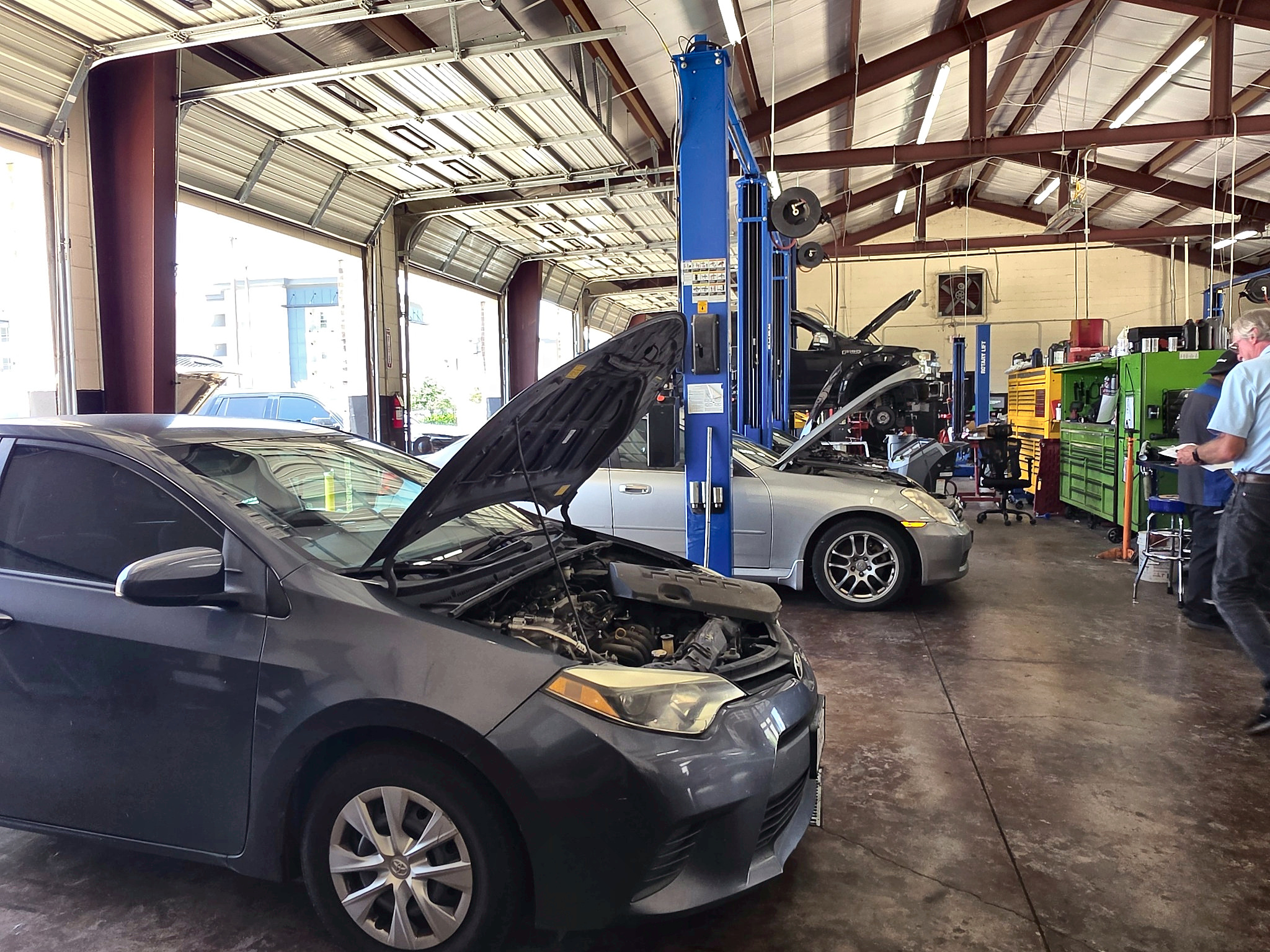
Katy drivers put a specific kind of load on a brake system. Not the crawling, bumper-to-bumper grind you get closer to downtown — but repeated hard decelerations from 70 mph on the Grand Parkway and I-10, in vehicles that keep getting heavier. That combination wears brakes in a predictable order, and it is why brake service in Katy, TX is the single most common job in our bays on W Grand Pkwy N.
- Speed matters more than traffic. Stopping energy rises with the square of speed — a 70-mph stop is roughly four times the heat of a 35-mph one.
- Weight compounds it. Three-row SUVs, half-ton trucks and EVs ask far more of the same size brake.
- Pads, then rotors, then fluid. Wear arrives in that order, and skipping the middle step is the expensive mistake.
- Nothing flags it now. With the Texas safety inspection gone, a voluntary inspection is the only early warning left.
Quick answers
How long should brake pads last in Katy?
Anywhere from 25,000 to 70,000 miles. The spread is that wide because it depends on vehicle weight and how you drive: a three-row SUV commuting the Grand Parkway at highway speed converts far more energy into heat per stop than a sedan on neighborhood streets.
Why do my brakes shudder at highway speed but feel fine around town?
That is the signature of uneven rotor thickness or heat-related distortion. It shows up at speed because the pedal pulse scales with wheel rotation. Around town the effect is small enough to miss.
Do I need new rotors every time I replace pads?
No, but you do need them measured. Rotors have a minimum thickness spec stamped on them. If there is material left and the surface is true, resurfacing or reuse is fine — if not, new pads on bad rotors will simply repeat the problem.
Why highway braking is harder on brakes than city traffic
A brake does one job: turn motion into heat and get rid of it. The amount of heat scales with the square of your speed, so slowing from 70 to 20 on the Grand Parkway when traffic bunches up releases roughly four times the energy of the same stop from 35 in a subdivision. Do that twice each way, five days a week, and you have a heat problem rather than a friction problem.
Heat is what warps rotors, glazes pad material, and cooks the moisture out of — and eventually into — brake fluid. It is a different failure path from the constant low-speed cycling we describe in our Rosenberg guide to Highway 59 stop-and-go traffic, and it needs a different inspection focus: rotor runout and thickness variation rather than simple pad depth.
The weight problem nobody mentions at the dealership
The average vehicle in a Katy driveway is heavier than it was ten years ago. Three-row SUVs, crew-cab trucks and battery-electric crossovers all carry meaningful extra mass, and mass is the other half of the stopping-energy equation. Add a trailer or a boat headed out I-10 and you are asking a brake system sized for the vehicle to control the vehicle plus its load.
- Heavy daily drivers — expect shorter pad life than the owner's manual optimistically suggests.
- Towing — halve your inspection interval, and have the suspension checked at the same time, since load fatigues both systems together.
- EVs and hybrids — regenerative braking means pads last a long time but rotors can surface-rust from disuse, which produces its own noise and vibration.
- Alignment — a vehicle out of alignment loads one side harder and wears pads unevenly. Our alignment service and a look at the tire pressure monitoring system often explain a pull that owners assumed was a brake fault.
The order things actually fail
1. Pads. Friction material thins until the built-in metal wear indicator starts to squeal. That squeal is a feature, not a failure — it is the cheapest warning you will ever get.
2. Rotors. Ignore the squeal and pad backing plates start scoring the rotor face. Now you hear grinding, and a $200 job has become a $500 one. Heat cycling can also produce thickness variation without any metal-on-metal contact at all, which is the shudder-at-speed complaint we hear most often from Grand Parkway commuters.
3. Fluid and hydraulics. Brake fluid is hygroscopic — it absorbs moisture from the air, and Gulf Coast humidity gives it plenty to absorb. Wet fluid boils at a lower temperature, and boiling fluid means a pedal that sinks to the floor exactly when a hot brake needs to work hardest. Calipers seize, flex lines crack, and by then you are replacing components rather than servicing them.
Every one of those stages is visible in a photo before it is audible from the driver's seat. That is the whole argument for inspecting rather than waiting.
Nothing checks this for you anymore
Until January 2025, an annual Texas safety inspection put eyes on your brakes once a year whether you thought about them or not. That requirement is gone for non-commercial vehicles — we wrote up exactly what Texas drivers still owe in 2026, including the emissions test that survived and the fee that got renamed. The short version for Katy: if you want someone to notice your pads at 2 millimeters, you have to ask.
Asking is free here. Every oil change at our Katy shop includes a digital multi-point inspection, brakes included, with photos sent to your phone. If a dash light is already on, a check engine scan tells us whether the fault sits in the brake circuit, the ABS module or somewhere else entirely.
What a real brake inspection covers
- Pad thickness, measured — both sides, front and rear, with numbers you can see rather than an opinion.
- Rotor thickness and runout — measured against the manufacturer's minimum spec, not eyeballed.
- Fluid condition — moisture content, not just level.
- Calipers, hoses and hardware — seizing, leaking, sticking slide pins.
- Wheel bearings — a growl blamed on brakes is sometimes a wheel bearing.
- Tires and alignment — because stopping distance is a tire spec as much as a brake spec.
Pairing brake work with scheduled maintenance keeps intervals honest and avoids the deferred-repair spiral we broke down in our piece on maintenance debt in Katy.
Why Katy drivers use our Grand Parkway shop
Auto Care USA has been family-owned since 1988, and our Katy shop at 3127 W Grand Pkwy N runs ASE-certified technicians, digital inspections with photos, a courtesy shuttle, and financing through Affirm and Sunbit when a repair lands at a bad time. Every brake job is covered by our 2-year / 24,000-mile nationwide warranty — honored at all four of our Houston-area shops and at partner shops nationwide.
Frequently asked questions
Does towing change my brake service interval?
Substantially. Towing a boat or trailer out I-10 adds mass without adding braking capacity, which raises operating temperature and accelerates pad, rotor and fluid wear. Tow regularly and you should be inspecting brakes twice as often.
Now that Texas dropped the safety inspection, will anyone catch worn brakes?
Not automatically. The annual safety inspection ended for non-commercial vehicles in January 2025, so nothing external flags thin pads anymore. A free digital brake check at every oil change is how most of our Katy customers replaced that net.
Can I get brake work done same day?
Most pad-and-rotor jobs are same-day. Caliper or hydraulic repairs can take longer — we give you a firm timeline up front and a courtesy shuttle so you are not stranded.
Book a brake inspection in Katy
If your pedal pulses on the Grand Parkway, you hear a squeal at low speed, or you simply cannot remember the last time anyone looked, bring it in. Measured numbers, photos, and a straight answer about whether it can wait.
Related reading
- Essential Fall Car Maintenance in Spring, TX: How Texas Heat Impacts Your Vehicle
- Why Your Car AC Blows Warm Air: Complete Guide to AC Repair in Rosenberg, TX
- Why Late-Season Heat Causes Sudden Failures: Complete Guide to AC Repair in Katy, TX
- Texas Ended the Safety Inspection: What Briar Forest Drivers Still Owe in 2026
- Why Katy Auto Repair Shops Are Seeing a Surge in A/C and Brake Issues This Fall
- Beat the Heat: Why A/C Repair in Katy, TX Is Essential This August
- Why Professional Brake Repair in Rosenberg, TX Is Your Best Defense Against Highway 59 Traffic
- How to Beat Rising Auto Repair Costs in 2026: A Spring, TX Owner’s Guide
Free digital brake inspection
3127 W Grand Pkwy N, Katy, TX 77449 — walk-ins welcome.